
These modifications enhance its biological activity and extend its functional presence in circulation compared to native IGF-1.
Pre Order Today To Secure Launch Pricing
COA Provided With Every Order
Research Quality Peptides
99%+ Purity Guaranteed
Pre Order Today To Secure Launch Pricing
COA Provided With Every Order
Research Quality Peptides
99%+ Purity Guaranteed
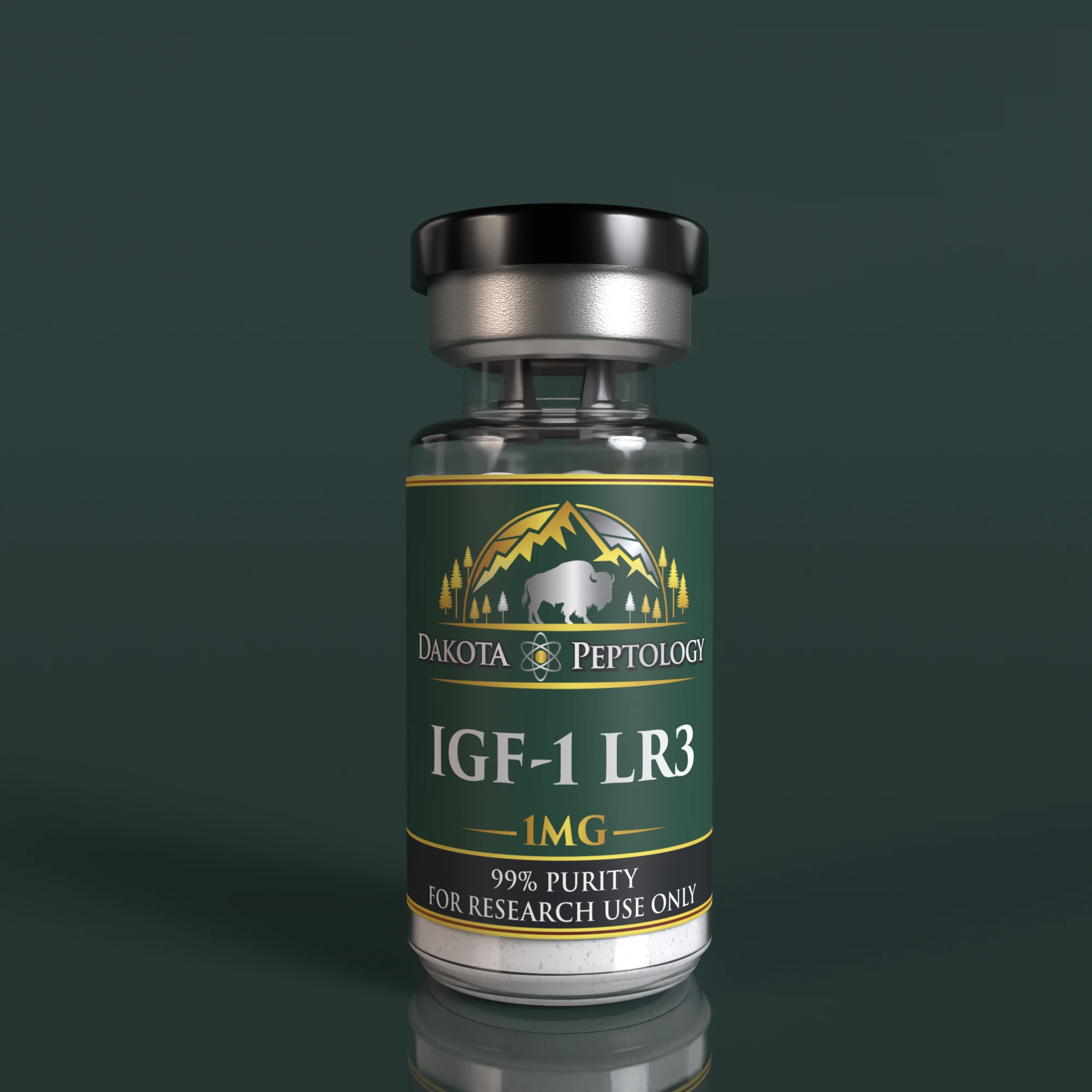
IGF-1-LR3 1MG
Categories: Muscle Growth & Performance, Peptides
IGF-1 LR3 is a modified peptide variant of insulin-like growth factor 1, designed for laboratory research applications. This research-use-only compound is intended for use in in vitro and in vivo experimental settings, offering insights into cellular and physiological mechanisms. Always follow proper biosafety protocols. For research use only.
$90.00
Satisfaction Guaranteed
Secure
Payment
Third-party
Tested
Research Use Disclaimer
Every serious peptide company prominently displays this. Example Research Use Only All products offered by Dakota Peptology are intended strictly for laboratory research purposes.
Research Use Disclaimer
Every serious peptide company prominently displays this. Example Research Use Only All products offered by TruPeptides are intended strictly for laboratory research purposes.
‘
IGF-1 LR3 (1-Methylcyclohexyl) 1mg
IGF-1 LR3 (1-Methylcyclohexyl) is a chemically modified variant of Insulin-like Growth Factor 1 (IGF-1), designed to enhance its stability and longevity in biological systems. This peptide is frequently studied in the research context for its potential effects on cellular signaling pathways, particularly in investigations into tissue regeneration, muscle protein synthesis, and metabolic processes. As a research-use-only product, IGF-1 LR3 is intended for laboratory testing and academic inquiry only.
IGF-1 LR3 has been evaluated for its role in modulating growth factors and protein synthesis mechanisms. The modification with the 1-Methylcyclohexyl group helps prevent rapid degradation by proteases, thereby extending its half-life in vitro and potentially influencing downstream biological responses. This characteristic makes it valuable for studies examining sustained signaling effects and tissue repair.
Research Overview
IGF-1 LR3 has been extensively explored in both in vitro and in vivo models for its ability to exert prolonged biological activity. Research indicates that this modification can significantly enhance the peptide’s resistance to enzymatic cleavage, allowing for prolonged exposure to target tissues. Studies have examined its effects on muscle regeneration, cellular proliferation, and metabolic regulation, contributing to a deeper understanding of its potential applications in basic science research.
Key Research Focus Areas
- Cellular Signaling Pathways: Investigation of IGF-1 LR3’s role in activating growth factor receptors and downstream signaling cascades, including Akt/mTOR and MAPK pathways, in various tissue types.
- Muscle Protein Synthesis and Regeneration: Evaluation of its impact on muscle fiber growth, repair, and resistance to atrophy, particularly in preclinical models of muscle degradation or atrophy-related conditions.
- Tissue Repair and Regeneration: Examination of IGF-1 LR3’s potential in accelerating tissue repair processes, including cartilage, bone, and soft tissue regeneration, through prolonged biological activity.
- Metabolic Regulation: Analysis of its effects on glucose metabolism, lipid homeostasis, and energy balance in research models, contributing to studies on aging and metabolic diseases.
- Protein Stability and Half-Life Extension: Characterization of how the 1-Methylcyclohexyl modification enhances IGF-1 LR3’s resistance to proteolytic degradation, improving its utility in prolonged exposure studies.
It is important to note that the biological effects of IGF-1 LR3 are highly dependent on experimental conditions, including dosing, delivery methods, and study models. Researchers should conduct thorough validation to ensure accurate interpretation of results in their specific experimental contexts.
For research use only. Not for human or animal consumption. This product is intended solely for academic and laboratory research purposes and should only be handled by qualified professionals adhering to established safety protocols and regulatory guidelines applicable to peptide research materials.
📚 Peer-Reviewed Study
IGF-1 LR3 and Growth Regulation: Evaluation of Metabolic Effects in Fetal Models
▼
📚 Peer-Reviewed Study
IGF-1 LR3 and Growth Regulation: Evaluation of Metabolic Effects in Fetal Models
Introduction to IGF-1 LR3
IGF-1 LR3 (Long R3 Insulin-like Growth Factor-1) is a synthetic analog of IGF-1 engineered for increased receptor affinity and reduced binding to IGF-binding proteins.
Research Objective
The referenced study aimed to evaluate whether IGF-1 LR3 could improve growth outcomes in fetal growth restriction (FGR), a condition associated with low IGF-1 levels and impaired metabolism.
Researchers also assessed its effects on insulin signaling, glucose metabolism, and amino acid availability.
Study Design and Methodology
In this study, growth-restricted fetal sheep were treated with IGF-1 LR3 via infusion for one week.
Measurements included fetal body weight, insulin levels, glucose concentrations, oxygen content, and glucose-stimulated insulin secretion (GSIS).
Key Findings — No Improvement in Growth Outcomes
IGF-1 LR3 treatment did not result in increased fetal growth or improvements in metabolic parameters compared to control groups.
Insulin levels, glucose concentrations, and GSIS remained unchanged, indicating limited anabolic impact in this model.
Metabolic Effects and Amino Acid Utilization
The study observed a significant reduction in circulating amino acids in treated subjects, suggesting increased amino acid utilization.
This may reflect metabolic activity without corresponding improvements in overall growth outcomes.
Mechanisms of Action
IGF-1 LR3 binds strongly to the IGF-1 receptor, activating signaling pathways involved in cellular growth and metabolism.
Its reduced interaction with binding proteins increases its bioavailability, though this study suggests that receptor activation alone may not be sufficient to drive growth under certain physiological conditions.
Implications for Growth and Metabolic Research
These findings highlight the complexity of growth regulation and suggest that IGF-1 LR3 alone may not overcome limitations associated with nutrient availability or hormonal imbalance.
The study emphasizes the importance of considering metabolic context when evaluating growth-promoting compounds.
Conclusion
IGF-1 LR3 did not improve growth outcomes in this fetal model despite its strong receptor activity.
These results suggest that additional metabolic factors are required for effective growth stimulation and support further investigation into its mechanisms.
Frequently Asked Questions (FAQ)
What is IGF-1 LR3?
IGF-1 LR3 is a modified form of insulin-like growth factor-1 designed for increased stability and receptor activity.
What does IGF-1 LR3 do?
It activates IGF-1 receptors involved in cellular growth, metabolism, and protein synthesis.
Did the study show growth improvement?
No. The study found no significant increase in growth or metabolic improvement in treated subjects.
What changed in the study?
Circulating amino acid levels decreased, suggesting increased metabolic utilization.
Is this based on human research?
No. The referenced study was conducted in a controlled animal model.
📚 Study Reference
White A. et al. Am J Physiol Endocrinol Metab. 2025.
No COA certificate available for this product.
Related Peptides
Related products
-
DSIP
$45.00 – $80.00Price range: $45.00 through $80.00This product has multiple variants. The options may be chosen on the product page -
MOTS-C
$90.00 – $225.00Price range: $90.00 through $225.00This product has multiple variants. The options may be chosen on the product page -
Bacteriostatic Water
$8.00 – $15.00Price range: $8.00 through $15.00This product has multiple variants. The options may be chosen on the product page -
Glutathione
$60.00 – $125.00Price range: $60.00 through $125.00This product has multiple variants. The options may be chosen on the product page